
Preparing a Maine Garden for Winter: A September Through December Timeline for Zone 5b

Written by Rebecca Pinkham Stevenson
A practical fall garden tending guide for Maine perennials, hydrangeas, hostas, peonies, iris, ornamental grasses, evergreens, shrubs, lawns, bulbs, and established gardens, beginning with what your property needs right now.
Preparing a garden for winter in Maine is not a single weekend project, and despite the familiar autumn temptation to cut everything down, rake everything away, fertilize everything one final time, and declare the landscape finished until April, the healthiest approach to winter preparation is considerably more deliberate than that.
A Maine garden begins preparing itself for winter long before the gardener puts away the tools.
As daylight shortens and nighttime temperatures fall, perennial plants begin shifting resources away from active top growth and toward their roots and crowns, deciduous shrubs and trees move toward dormancy, lawns respond to cooler conditions differently than they did during summer heat, and evergreen plants begin approaching the season when their ability to replace moisture will eventually become limited by frozen soil.
Our job during this period is therefore not to force the garden into winter.
It is to help the garden enter winter successfully.
For gardeners in USDA Zone 5b and similar parts of Maine, that means September, October, November, and the period immediately before permanent snow cover should each be treated differently, because the correct job in late September is not necessarily the correct job after several hard frosts, and something that benefits one perennial may be completely unnecessary or even counterproductive for another.
This year deserves particular attention because Maine is already entering autumn 2026 under significant drought stress. Maine's Drought Task Force reported widespread dry conditions across the state in early September after another summer of below normal rainfall, and the September 15 U.S. Drought Monitor showed continued deterioration, including extreme drought along portions of the Maine coastline.
That changes the priorities.
This is not the autumn to become so preoccupied with cutting plants down that we forget what is happening underground.
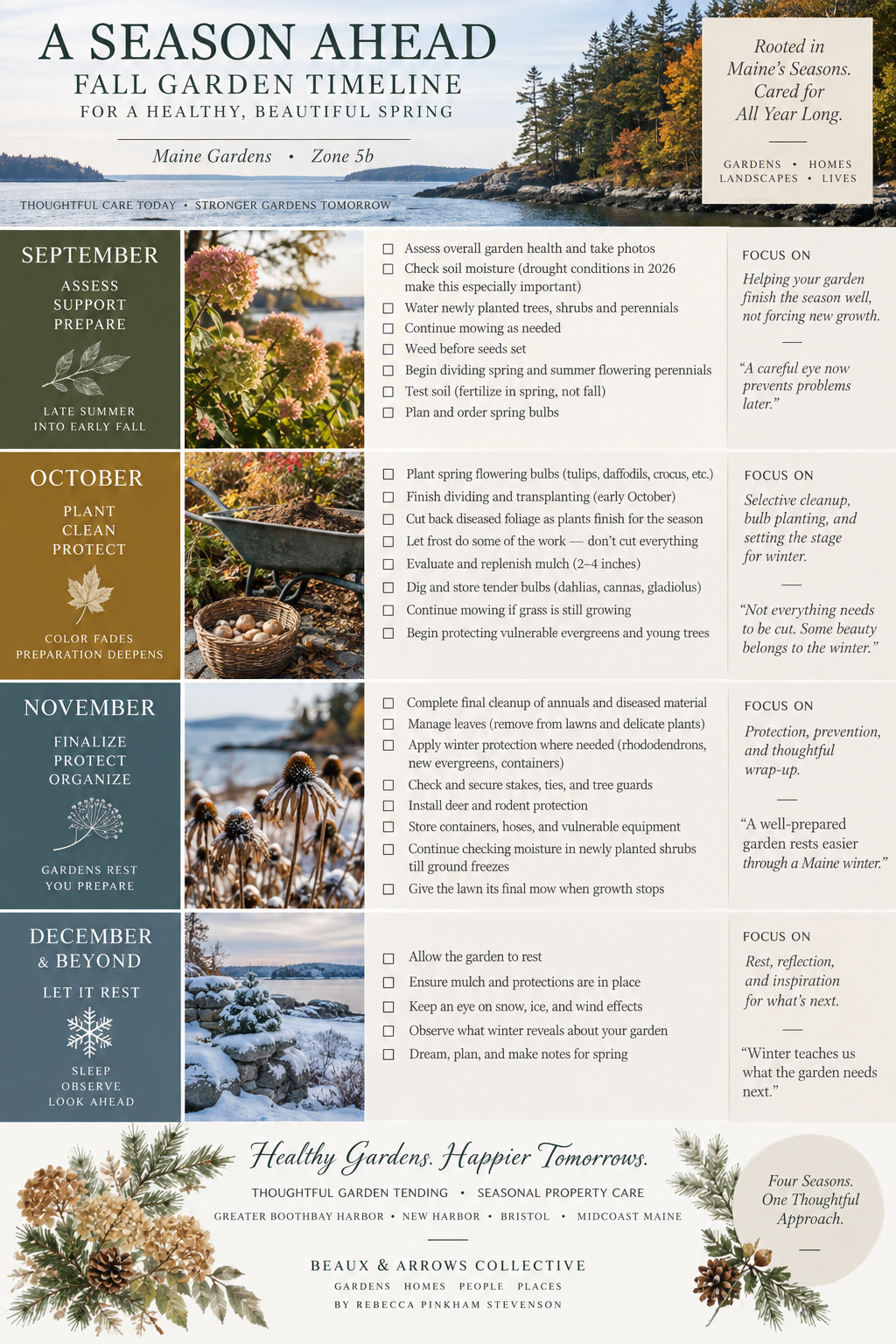
September 21 through the end of September: assess before you clean
Late September should begin with observation rather than demolition, because this is one of the last opportunities to see the garden while enough of its structure remains visible to understand what actually happened during the growing season.
Walk the property slowly and look at which plants performed beautifully, which struggled, which became too large for their locations, which disappeared behind their neighbors, where weeds repeatedly established themselves, which plants were browsed by deer, where the lawn failed, where water collected when rain did arrive, and which areas became dramatically drier than expected.
Take photographs now.
By April, you will remember that something bothered you beside the porch, but you may have absolutely no recollection of whether it was the hydrangea, the hosta, the phlox, or the enormous daylily swallowing the edge.
The University of Maine Cooperative Extension similarly recommends using September to photograph and record garden observations, particularly plants that need future transplanting, pruning, dividing, or other attention, because those problems become considerably harder to remember once the garden disappears for winter.
For a garden that I tend regularly, this is also when I begin mentally constructing the following year's plan.
Not everything needs to be fixed now.
Some things simply need to be remembered.
Right now, water deserves more attention than cutting things down
Because of Maine's current drought conditions, I would place moisture assessment very high on the late September priority list, particularly for newly planted trees and shrubs, recently divided or transplanted perennials, broadleaf evergreens, conifers, and anything installed during the 2026 growing season.
Do not determine soil moisture simply by looking at the surface.
Dry soil can appear deceptively similar from above regardless of how much moisture exists several inches below, while a brief rain can darken the surface without adequately rehydrating the root zone.
Check.
Push into the soil.
Dig a small test hole away from important roots if necessary.
Understand what is happening beneath the mulch before deciding that rainfall solved the problem.
At the same time, do not turn autumn drought into indiscriminate overwatering. Established perennials naturally begin preparing for dormancy during this period, and University of Maine guidance has cautioned against using late season watering or fertilization in ways that stimulate tender new growth.
The objective is not to convince the garden that spring has returned.
The objective is to prevent drought stressed roots from entering a Maine winter unnecessarily dehydrated.
That distinction matters.
Late September: stop trying to make plants grow
One of the most important changes in fall garden care is psychological.
Spring gardening asks, How do I encourage growth?
Autumn gardening increasingly asks, How do I help this plant finish?
Those are different objectives.
This is generally not the moment for indiscriminate fertilization of established perennial beds, shrubs, and trees in an attempt to give them one final burst of energy, particularly if the fertilizer could stimulate soft new growth that has insufficient time to harden before freezing weather.
University of Maine Extension recommends soil testing in autumn if it has been several years since the last test, while noting that spring is generally the better time for garden fertilization.
That is an excellent distinction.
Test now. Plan now. Correct intelligently later.
Do not throw fertilizer at a garden simply because autumn feels like the time to “feed everything before winter.”
Late September is also your final serious lawn window
The lawn operates on a slightly different calendar from the perennial garden.
Cool season grasses can become active again as temperatures moderate, which is why autumn mowing may continue well beyond the point when the perennial beds begin looking tired.
University of Maine recommends mowing according to actual growth rather than the calendar and notes that higher mowing generally supports more leaf area, photosynthesis, and deeper root systems. Its Maine lawn guidance also recommends continuing late fall mowing as necessary rather than leaving excessively long turf beneath winter snow, which can contribute to conditions favorable to snow mold.
If you were planning substantial lawn renovation or overseeding, however, the ideal Maine window is already closing. University of Maine identifies approximately August 15 through September 15 as the most successful late summer period for major lawn renovation, although smaller repairs may still be approached according to local conditions.
That means September 21 is not the moment I would enthusiastically begin an enormous lawn reconstruction simply because the calendar says “fall.”
I would assess first.
Bare areas caused by drought, shade, compaction, drainage, insects, or poor soil will simply return if the underlying cause remains unresolved.
A beautiful lawn begins with understanding why the ugly part became ugly.
Late September into early October: divide selectively rather than automatically
Fall is an excellent time to divide many established perennials, but the word many matters.
University of Maine Extension recommends generally dividing spring and summer flowering perennials in fall while leaving fall flowering perennials for spring division.
That provides an excellent working rule for common Maine gardens.

Peonies
If an established peony needs to be divided or relocated, early fall is an appropriate time to do it, and this is one perennial for which planting depth deserves particular attention because peony eyes buried too deeply can result in beautiful foliage with disappointing flowering.
If the peony is healthy, flowering beautifully, and appropriately located, however, there is no prize for disturbing it.
Leave successful plants alone.

Iris
Bearded iris that became overcrowded, flowered poorly, or developed congested rhizomes can be divided, although earlier late summer division generally gives them more establishment time before winter.
If you are working late in September in Zone 5b, I would prioritize only plants that genuinely need intervention rather than dividing everything simply because it can theoretically be done.

Hostas
Healthy hostas can be divided, but again, necessity matters.
If a hosta has become enormous and is swallowing neighboring plants, dividing it can improve the composition and give you additional plants for another area of the property.
If it is magnificent exactly where it is, allow magnificence to continue.

Daylilies
Overgrown clumps can be divided and relocated, particularly when flowering has declined or they have exceeded the intended boundaries of a bed, but drought stressed plants deserve additional judgment this year because transplantation creates another demand on an already stressed root system.

Phlox and other summer flowering perennials
Healthy spring and summer flowering perennials can often be divided in fall, particularly when they have become congested, but the same principle applies throughout the garden: do not manufacture work merely because a horticultural calendar says a task is possible.
A good gardener is constantly deciding what not to disturb.
Early October: plant spring bulbs while you still remember how empty April looked
One of autumn gardening's great acts of optimism is burying something in cold soil and trusting that six months later it will announce spring.
Tulips, daffodils, crocus, alliums, and other hardy spring flowering bulbs can be planted in fall before the ground freezes, and University of Maine specifically recommends fall planting of spring flowering bulbs.
This is also the moment to think compositionally rather than buying random bags because the photograph on the package is beautiful.
Ask what the garden actually needs in April and May.
Where can you see flowers from inside the house?
Where does snow disappear first?
Where are you walking in early spring?
Which perennial beds remain visually empty until June?
Where would a substantial drift of daffodils create more impact than twelve unrelated varieties scattered individually throughout the property?
Spring bulbs are most successful visually when they solve a seasonal gap rather than merely occupy soil.
October: do not cut every perennial to the ground
This is probably one of the most important changes homeowners can make to conventional fall cleanup.
A perennial becoming brown does not automatically mean it has become useless.
Some standing stems and seed heads provide winter structure, some offer food or habitat for wildlife, some help collect snow around plant crowns, and some simply look beautiful when frost and snow arrive.
There are also plants whose diseased foliage should absolutely be removed.
This means fall cleanup should be selective.
Hostas
Hosta foliage will collapse after frost and eventually become soft, flattened material that can be removed once it has died back.
If foliage showed significant disease problems during the growing season, removing affected material from the garden rather than leaving it in place becomes particularly sensible.
Peonies
Peony foliage is one of the plants I am more inclined to remove after frost, particularly where fungal disease has been present.
Cut the dead foliage down after it has finished for the year, clean the area, and avoid leaving diseased material sitting around the crown.
Daylilies
Once foliage yellows and collapses, it can be cleaned away, particularly where maintaining a tidy garden is important.
There is little benefit in wrestling with healthy green foliage merely because October arrived.
Let the plant finish first.
Garden phlox
If powdery mildew or other disease was substantial, removing affected foliage can reduce the amount of diseased material left in the garden.
Black eyed Susans, coneflowers, asters, sedum, and ornamental grasses
These are among the plants I am often more inclined to leave standing where appropriate because their seed heads and structural forms can contribute to the winter garden and provide ecological value.
A garden does not need to enter December looking as though every living thing has been erased from it.
Hydrangeas need identification before they need pruning
This deserves its own rule because Maine homeowners lose an extraordinary number of flowers by treating every hydrangea as though it were the same shrub.
Before cutting a hydrangea substantially, know which hydrangea you have.
Panicle hydrangeas, smooth hydrangeas, bigleaf hydrangeas, mountain hydrangeas, and oakleaf hydrangeas do not all flower according to the same growth pattern, and therefore they should not all be pruned according to the same calendar.
If you are uncertain what you have, fall is an excellent time to do something remarkably sophisticated:
Nothing.
Remove obviously dead or damaged material if necessary, document the shrub, identify it properly, and make the pruning decision when you understand how that particular plant produces flowers.
A hydrangea does not need to be reduced to a tidy little bundle simply because winter is coming.
In many Maine landscapes, leaving the flower heads and structure intact through winter is both aesthetically beautiful and horticulturally preferable to indiscriminate autumn pruning.
Evergreen shrubs need a completely different kind of winter preparation
Arborvitae, rhododendrons, boxwood, junipers, yews, spruce, pine, fir, and other evergreen plants remain physiologically different from herbaceous perennials because they retain living foliage through winter.
That foliage can continue losing moisture even when the ground is frozen and roots can no longer replace it efficiently.
This is why entering winter adequately hydrated matters particularly for evergreens, especially recently planted material and plants exposed to strong winter winds.
For coastal and exposed Maine properties, I am also looking at the physical environment around those plants.
Is an arborvitae hedge positioned where plowed snow will be thrown against it?
Will road salt reach it?
Is a broadleaf evergreen exposed to prevailing winter wind?
Is a newly planted conifer standing in an area where snow sliding from a roof could crush it?
Is an upright evergreen likely to split beneath heavy wet snow?
Winter preparation is not only about temperature.
It is about understanding what winter will physically do to that particular location.
Rhododendrons deserve particular attention before frozen ground
Rhododendrons and other broadleaf evergreens can be vulnerable to winter desiccation because they retain leaf surface throughout winter.
A well established plant in an appropriate protected location may need very little intervention, while a recently planted rhododendron exposed to winter sun and wind deserves considerably more attention.
The goal is not to wrap every shrub on the property in burlap until the landscape resembles a collection of packages.
Use protection where the exposure justifies it.
A wind barrier can be more useful than wrapping material tightly against foliage, particularly when the objective is reducing desiccating wind rather than trapping moisture against the plant.
Arborvitae: prepare for snow as well as cold
Arborvitae are extraordinarily common throughout Maine because they provide year round screening, structure, and privacy, but their upright forms can be vulnerable to heavy snow and ice, particularly when plants have developed multiple leaders or open structures.
Before winter, inspect them.
Remove genuinely dead material.
Look for structural weakness.
Make sure recently planted arborvitae are not entering winter severely dry.
Consider whether particularly vulnerable specimens need appropriate support against snow loading, while avoiding materials or tying methods that constrict or damage stems.
And if the arborvitae are beside a driveway, road, or parking area, think about salt before the first plow arrives.
The problem you prevent in November is considerably easier than the brown hedge you try to diagnose in May.
Mid October: mulch, but do not bury your plants
Mulch is valuable because it moderates soil temperature, reduces moisture loss, suppresses weeds, and can help protect roots through winter, and University of Maine recommends fall as an appropriate time to replenish mulch where needed.
More is not automatically better.
A perennial crown should not disappear beneath an enormous mound.
Tree trunks should not emerge from mulch volcanoes.
Shrub stems should not remain permanently wet because mulch has been piled against them.
The objective is to protect the root zone and soil, not suffocate the plant.
In many established ornamental beds, approximately a few inches of appropriate mulch is far more useful than continually adding new layers every year without accounting for what remains underneath.
Before adding more, look.
You may already have enough.
Late October: allow frost to make some decisions for you
The first meaningful frosts simplify the garden.
Tender annuals collapse.
Hostas begin disappearing.
Some perennial foliage changes rapidly.
Dahlias, cannas, gladiolus, and other non hardy plants announce that their season is finished.
University of Maine recommends digging tender bulbs and tubers such as cannas, gladiolus, and dahlias after their foliage dies back, then storing them under appropriate cool, dry, ventilated conditions above freezing.
This is the point when fall cleanup can become more aggressive because the garden itself has begun clearly separating what remains useful from what is finished.
I still would not indiscriminately clear every stem.
Instead, I work through the beds plant by plant.
Remove what is diseased.
Remove what has collapsed into paths.
Remove material likely to become a wet, matted mess.
Leave structurally attractive and ecologically useful stems where appropriate.
The garden should look intentionally prepared, not sterilized.
Late October into November: leaves are a resource before they are waste
Leaves become a problem when they form thick, wet mats across lawns, evergreen groundcovers, drainage areas, walkways, and delicate plants.
They are not inherently a problem simply because they fell from a tree.
Where practical, leaves can be shredded and incorporated into appropriate garden systems, composted, used in designated areas, or left in portions of the landscape where they provide habitat and gradually return organic matter to the soil.
This is another place where property wide thinking matters.
The objective should not automatically be to remove every leaf from the property.
The objective is to remove leaves from places where they create problems and use or retain them where they provide value.
A lawn buried beneath a dense layer of wet maple leaves is different from a woodland garden naturally accumulating leaf litter.
Treating those areas identically makes little ecological or horticultural sense.
Continue mowing while the lawn continues growing
Do not put the mower away simply because the calendar says November.
If grass is still growing, continue mowing as conditions allow.
The final cut should leave the lawn reasonably tidy going into snow season without scalping it.
University of Maine notes that lawns grow according to environmental conditions rather than dates and specifically identifies late fall mowing as one practice that can help reduce conditions favorable to snow mold beneath prolonged snow cover.
This final period of mowing is also an excellent opportunity to keep leaves from matting heavily into turf, either through collection or appropriate mulching where conditions permit.
The lawn you leave in November becomes the lawn you uncover in spring.
November: shift from gardening to winter protection
By November, particularly after repeated freezes, the objective begins changing again.
You are no longer trying to improve summer appearance.
You are protecting the investment already in the ground.
Inspect newly planted trees and shrubs.
Check stakes and ties where they were actually necessary.
Protect vulnerable trunks from rodents where appropriate.
Think about deer browsing before winter eliminates their preferred food sources.
Make sure protective barriers are installed before animals establish winter feeding habits.
Consider exposed evergreens.
Remove garden supports that could become hazardous or leave appropriate structural supports where plants require them.
Store containers that are vulnerable to freeze thaw damage.
Drain hoses and irrigation components as appropriate.
Clean and store tools.
Prepare equipment.
Finish removing diseased plant debris.
And perhaps most importantly this year, continue paying attention to soil moisture until the ground actually freezes rather than assuming cold weather means roots can no longer experience drought.
What about perennial plants in containers?
A perennial hardy to Zone 5b when planted in the ground is not automatically equally hardy sitting above ground in a decorative pot.
Roots in containers experience colder temperatures because they lack the insulation provided by surrounding soil.
University of Maine specifically recommends protecting overwintering perennial containers by insulating the root ball and shielding plants from drying winter winds; it also notes that a two to three inch mulch layer can help protect the root zone.
For valuable container perennials, consider whether pots can be heeled into the ground, grouped in a protected location, moved into an appropriate unheated protected structure, or otherwise insulated according to the plant and container involved.
Do not assume that because the tag says “Zone 5” the roots are equally protected while sitting three feet above frozen ground on a deck.
Late November into December: protect against winter, but resist overprotecting
Once the ground begins freezing consistently, the active garden season is essentially ending, but winter protection can still be refined.
Mulch should be where it belongs.
Sensitive plants should have appropriate protection.
Evergreens should be prepared for wind and snow exposure where necessary.
Deer and rodent protection should be established.
Tender bulbs and tubers should already be stored.
Tools should be clean.
Hoses should be dealt with.
The lawn should have received its final appropriate mowing.
Diseased plant material should not be sitting in piles beside susceptible plants.
But the garden does not need to disappear beneath burlap, plastic, mulch, and anxiety.
Plants hardy to Maine are supposed to experience winter.
Our goal is not to keep them warm.
Our goal is to prevent avoidable damage while allowing dormancy to occur normally.
What should stay standing all winter?
This is where winter garden design and ecological gardening meet.
Ornamental grasses can be beautiful beneath snow.
Sedum seed heads can remain architecturally interesting for months.
Coneflowers and black eyed Susans can provide seed and winter texture.
Asters and other sturdy perennial stems can contribute habitat.
Hydrangea flower heads can hold snow beautifully.
Strong stems can create little structures around which snow accumulates, providing additional insulation near crowns.
You do not need to keep everything.
You also do not need to remove everything.
The most beautiful winter gardens often contain enough structure that you can still understand where the garden is after the flowers are gone.
What should definitely be cleaned up?
Diseased material deserves a different standard.
If foliage experienced substantial fungal or bacterial problems, leaving infected debris immediately around susceptible plants can provide overwintering material for future problems.
Likewise, heavily infested or problematic plant material should be handled according to the particular pest or disease involved rather than automatically thrown into a home compost system that may never reach temperatures sufficient to destroy it.
Peony foliage affected by disease, badly mildewed phlox, diseased leaves, rotting annuals, and similar material are not contributing the same ecological value as healthy standing stems.
“Leave the garden for wildlife” should not become an excuse for leaving known disease problems in place.
Ecological gardening still requires judgment.
And what should wait until spring?
More than many homeowners think.
Many ornamental grasses can remain standing until late winter or early spring.
Many seed bearing perennial stems can remain.
Hydrangeas whose identity or pruning requirements are uncertain can wait.
Major reshaping of many woody plants can wait for the correct species specific pruning window.
Fall blooming perennials that need division can generally wait until spring, consistent with University of Maine's recommendation to divide fall flowering perennials in spring rather than disturbing them while they are completing their season.
There is enormous value in knowing when not to perform a task.
A practical Zone 5b Maine winter preparation timeline
September 21 through September 30: Assess drought stress, check actual soil moisture, photograph gardens, document problem areas, continue mowing according to growth, selectively divide appropriate spring and summer flowering perennials where conditions allow, weed before weeds seed, evaluate lawn damage, begin bulb planting, and avoid unnecessary late fertilization.
October 1 through October 15: Continue spring bulb planting, complete priority transplanting and division while adequate establishment time remains, clean diseased material, continue weeding, restore important bed edges, evaluate mulch depth, monitor recently planted trees and shrubs, continue lawn care, and begin identifying plants requiring winter protection.
October 15 through the first hard frosts: Allow tender plants and herbaceous perennials to begin natural dieback, selectively cut back collapsed or diseased foliage, leave useful seed heads and structural stems, dig tender dahlias, cannas, and gladiolus after frost finishes their foliage, continue mowing if turf remains actively growing, and keep leaves from forming dense mats across lawns and vulnerable plantings.
Late October through November: Finish major cleanup, manage leaves intelligently, complete the final lawn mowing when growth stops, protect vulnerable evergreens and young woody plants where exposure warrants it, prepare deer and rodent protection, secure vulnerable arborvitae where necessary, address containers, clean tools and equipment, and continue checking moisture in recently planted or drought stressed woody plants until the soil freezes.
After the ground begins freezing: Allow the garden to rest, use winter mulch where particular plants benefit from it, avoid unnecessary disturbance, leave appropriate stems and seed heads for winter interest and habitat, and begin observing how snow, wind, ice, drainage, plowing, salt, and wildlife interact with the landscape.
Because winter is not merely something the garden survives.
Winter teaches you about the garden.
The best winter preparation is not the garden that looks the cleanest in November
It is the garden that returns strongest in May.
That distinction changes the way I approach fall garden tending throughout Maine.
I am not trying to make every perennial disappear because brown stems offend our autumn sense of order, nor am I interested in performing tasks simply because they have traditionally appeared on a generic fall cleanup checklist.
I want to know what I am cutting before I cut it, what I am moving before I disturb its roots, what I am protecting before I wrap it, and what problem I am actually solving before I spend time and money solving it.
Some plants need to be cut.
Some need to stand.
Some need division.
Some should not be touched.
Some need water.
Some need drainage.
Some need mulch.
Some already have too much.
Some evergreens need protection from wind.
Others have spent twenty Maine winters in exactly the same location without asking us for anything at all.
And sometimes the most useful thing a gardener can do is recognize that a plant is already doing perfectly well and leave it alone.
This year, with significant drought conditions affecting Maine as we enter fall 2026, that kind of observation becomes even more important. A landscape that has spent much of summer managing insufficient rainfall should not automatically receive the same autumn treatment it would receive after a cool, wet growing season.
Winter preparation should respond to the garden that actually exists in front of us.
Not the calendar.
Not a generic checklist.
Not what somebody's garden in Virginia needs in October.
This garden. This soil. This exposure. This season. This Maine winter.
That is the difference between fall cleanup and garden tending.
The Beaux & Arrows Collective
Garden Tending + Seasonal Property Care by Rebecca Pinkham Stevenson
Greater Boothbay • Boothbay Harbor • East Boothbay • Southport • Edgecomb • New Harbor • Bristol • Midcoast Maine
Fall Garden Tending • Winter Preparation • Perennial Care • Hydrangeas • Peonies • Hostas • Iris • Ornamental Grasses • Evergreens • Arborvitae • Rhododendrons • Bulb Planting • Dividing + Transplanting • Lawn Care • Precision Edging • Seasonal Cleanup • Garden Stewardship
Do not simply put the garden to bed. Prepare it to wake up beautifully.