
The Complete Boudoir Photography Prep Guide: How to Prepare for Your Boudoir Session
Written by Rebecca Pinkham Stevenson
A thoughtful, extensive guide to boudoir wardrobe, lingerie, skin, hair, nails, grooming, beauty appointments, emotional preparation, posing, privacy, what to bring, what to avoid, and everything I want you to know before stepping in front of a camera.
There is an enormous amount of advice available about preparing for a boudoir photography session, and unfortunately, much of it begins with the subtle suggestion that the woman being photographed should spend several weeks correcting herself before she arrives.
“Drink more water so your skin looks better”
“Exercise so your body looks tighter”
“Eat differently so your stomach looks flatter”
“Whiten your teeth… tan your skin… remove your body hair… buy lingerie… perfect your nails… exfoliate everything… moisturize everything… sleep perfectly… avoid salt… avoid bread… avoid bloating altogether… and don’t forget to emerge on the morning of your session as a flawlessly polished woman who bears only a slight passing resemblance to the person who originally booked it.”
That is not how I want you to prepare.
I am Rebecca Pinkham Stevenson, founder and Creative Director of The Beaux & Arrows Collective, and I believe there is an important difference between preparing thoughtfully for professional photographs and treating your body as a problem that needs several weeks of corrective work before it is worthy of being photographed.
Thoughtful boudoir preparation process should eliminate distractions, give us more creative possibilities, protect your skin from unnecessary irritation, help clothing fit and move beautifully, make the morning of your session easier, and allow you to walk into the studio knowing that the practical details have already been handled. It should not leave you hungry, exhausted, over exfoliated, sore from a workout, anxious about five pounds, covered in unfamiliar beauty products, or convinced that one imperfect toenail has somehow jeopardized the entire experience.
I want you to prepare yourself and all that is surrounding the experience so that your body is free to simply exist within it.
That distinction is the foundation of this entire guide.

First, decide what you want to remember about yourself
Before you begin shopping for lingerie, scheduling beauty appointments, saving boudoir photography ideas to Pinterest, or wondering whether there is anything about your body you should change before your session, I want you to begin somewhere considerably more personal: when you eventually look back at these photographs, what do you want to remember about the woman you were when they were taken?
It is one of the most important questions I can ask while helping someone prepare for a boudoir photography session, because beautiful boudoir portraits are not created simply by assembling lingerie, professional hair and makeup, flattering poses, and beautiful light. Those things certainly contribute to the finished photographs, but they cannot tell me whether you want to feel soft or powerful, romantic or editorial, beautifully feminine or wonderfully undone, playful or quietly intimate, glamorous or almost completely natural. They cannot tell me whether you want to celebrate the body you have always loved, make peace with a body that has changed, rediscover a part of yourself that has been buried beneath work or motherhood or responsibility, or simply have photographs made because you have spent years documenting everyone you love and would finally like to exist beautifully within your own history.
This is why my first piece of advice for anyone wondering how to prepare for a boudoir session has very little to do with physical preparation.
Before we decide what you should wear for boudoir photographs, how your hair should be styled, whether you want professional makeup, what colors photograph beautifully, or which pieces you should bring to the studio, I want to understand how you want to recognize yourself when the photographs are finished.
Perhaps you want to see softness because you have spent years being capable for everyone around you and rarely make room for that side of yourself. Perhaps you want to see strength because your body has carried you through something extraordinary. You may want to celebrate turning thirty, forty, fifty, sixty, or seventy; commemorate a wedding or anniversary; document your body before or after motherhood; recognize physical changes you worked incredibly hard for; reconnect with yourself after a difficult season; or simply capture this particular version of yourself before time quietly carries you into the next one.
The most useful boudoir inspiration therefore begins with feeling rather than appearance.
You may absolutely want sensual, daring, provocative photographs, but you may instead want to look elegant, feminine, powerful, romantic, artistic, mature, joyful, sophisticated, beautifully soft, or simply like the most extraordinary version of yourself. A photograph can reveal very little skin and feel profoundly intimate, while another can reveal almost everything and still feel editorial. There is no required amount of exposure, no correct version of femininity, and no single personality you need to perform simply because you have booked a boudoir session.
What matters to me is authenticity to your body, your personality, your boundaries, and this particular season of your life. You are allowed to love your shoulders and feel uncertain about your stomach. You can adore your curves and dislike a particular angle. You can want your scars visible, your stretch marks untouched, your tattoos celebrated, or an area you feel sensitive about photographed with greater care. You do not have to arrive having achieved perfect body confidence, because boudoir is not an examination you pass after finally learning to love every inch of yourself.
I would much rather understand what you already love, what you want to rediscover, what you are curious to see differently, and what you simply do not want emphasized.
These conversations give me meaningful creative information while allowing you to talk about your body without allowing you to criticize it.
There is also another woman worth considering while planning your boudoir photographs: the future version of you who will eventually inherit them.
Ten or twenty years from now, she may see this body very differently than you see it today. She may notice the strength in your legs, the softness of your skin, the shape of your hands, the freckles across your shoulders, the tattoos you had then, the jewelry you wore every day, the way your hair fell, the beginning of lines around your eyes, or the expression you made when you had finally stopped worrying about the camera. The five pounds you were considering losing before your boudoir session may be completely meaningless to her, while the details you barely noticed may become precisely what makes the photographs priceless.
That is why I like beginning boudoir preparation with a very small exercise. Before the wardrobe planning, before the beauty appointments, and before we begin deciding what the photographs should look like, take a moment and finish these sentences without trying to produce the “right” answers:

[PRINT ME]
And perhaps the most important one…
When I leave my boudoir session, I hope I feel:
Those answers tell me considerably more about how to photograph you than a shopping bag filled with lingerie ever could, because once we understand what you actually want to preserve, every practical part of your boudoir session can begin serving that intention. We can choose wardrobe because it feels like you rather than because it is conventionally “boudoir,” style your hair and makeup to enhance rather than disguise you, choose how much skin you actually want to show, create poses around your body rather than forcing your body into someone else's poses, and build photographs around the woman standing in front of my camera rather than an imaginary woman we decided she needed to become.
Your body is not the preparation project
I want to address this early because nearly every other recommendation in this guide can become harmful if this principle gets lost underneath it.
You do not need to lose weight before boudoir.
You do not need to gain weight.
You do not need to flatten your stomach, build your glutes, tighten your arms, change your breasts, tan pale skin, conceal dark skin, erase stretch marks, hide scars, remove body hair, cover freckles, disguise age, change your teeth, or become more conventionally feminine.
If there is something you genuinely want to change because you want to change it, that decision belongs to you and exists independently of my camera.
What I do not want is for booking boudoir to suddenly place your body under six weeks of surveillance.
One of the crueler habits many women develop before photographs is beginning to inspect themselves from increasingly unflattering angles, as though they are trying to discover every possible objection before the camera can. They stand under bathroom lighting, bend strangely in mirrors, pinch areas of skin, photograph themselves from below, compare themselves with women online, and eventually arrive for professional portraits more critical of their bodies than they were when they booked them.
Please do not train yourself to dislike your body in preparation for photographs intended to celebrate it.
My responsibility is to understand light, lens choice, perspective, composition, posing, movement, wardrobe, proportion, expression, and the relationship between your body and the environment around it.
You are not required to learn photography by changing your anatomy.
Six to eight weeks before: build the idea before you build the wardrobe
If you have plenty of time before your session, use these early weeks for exploration rather than intervention.
Look at photographs, but pay attention to why you respond to them.
Do you love the clothing, or do you love the light?
Do you actually want that pose, or do you like the woman's expression?
Do you like the amount of skin showing, or the fact that the photograph feels intimate without being explicit?
Are you attracted to the room, the colors, the styling, the softness, the grain, the movement, the simplicity, or the confidence?
Separating those things prevents inspiration from becoming imitation.

Your early planning checklist
□ Choose three to five words describing how you want the finished photographs to feel.
□ Look through your own closet before buying anything.
□ Review complete public client galleries, when available, rather than judging a photographer only from a handful of portfolio highlights.
□ Think about whether these photographs are primarily for you, a partner, a wedding gift, an anniversary, a birthday, a life transition, or simply because you want them.
□ Consider whether you ultimately want digital photographs, an album, framed artwork, a private folio collection, gifts, or several finished forms.
□ Tell your photographer about any mobility limitations, injuries, chronic discomfort, sensory concerns, accessibility needs, or positions you already know are uncomfortable so posing can be designed around your body rather than against it.
□ Begin scheduling any routine beauty appointments that require advance booking.
□ If you are considering significant hair color changes, tattoos, cosmetic treatments, or other appearance changes, allow considerably more healing or adjustment time than you think you will need.
Should you look at other women's boudoir photographs?
Yes, with one important qualification: use other women's photographs to understand photography, not to establish the body you believe you are supposed to have.
Real client galleries can be especially useful because they reveal far more about a photographer than a collection of isolated portfolio images. They allow you to see how a photographer creates variety, handles different bodies, uses a location, transitions between expressions, approaches retouching, and maintains consistency across an entire session. Other boudoir resources similarly recommend looking at real client work while being careful about allowing inspiration to become comparison.
When you find an image you love, instead of saying, “I want to look like her,” identify the actual ingredient:
I love how relaxed this feels.
I love that she is laughing.
I love the shadows.
I love that this looks like a fashion editorial rather than traditional boudoir.
I love how her hands are positioned.
I love that she is wearing ordinary clothing.
I love that this is sensual without feeling overtly sexual.
Those observations are useful. Comparison rarely is.
Four to six weeks before: shop your own closet first
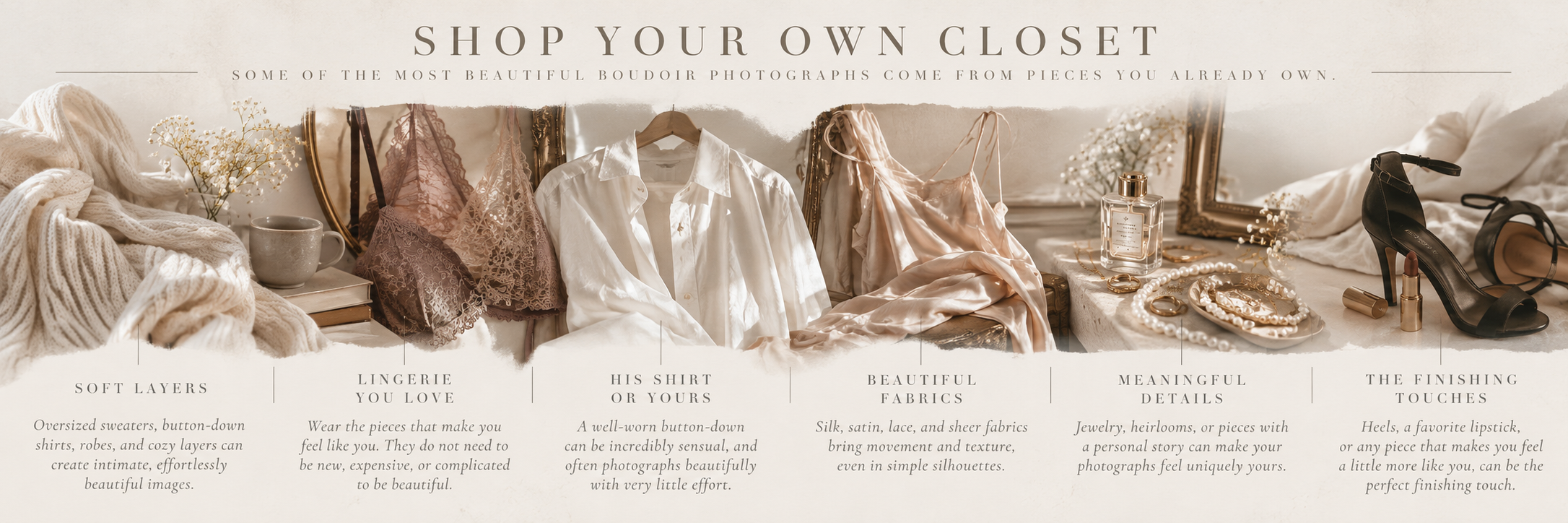
Boudoir has become so closely associated with lingerie that many clients understandably assume booking a session requires immediately purchasing several new sets.
It does not.
Before you buy anything, spend an evening looking through what you already own with different eyes.
An oversized white button down can photograph beautifully. So can a cashmere cardigan, a beautifully cut blazer, a fitted tank, a vintage slip, a soft robe, a favorite pair of jeans, a dramatic coat, an old concert T shirt, a silk dress, a wedding veil, a sweater with bare legs, a piece of fabric, your partner's shirt, or the thing in your closet that always makes you stand differently when you put it on.
Boudoir is not a product photography session for lingerie.
The wardrobe exists to reveal something about you.
Sometimes lingerie accomplishes that beautifully.
Sometimes your favorite jeans accomplish it better.
How do you know whether lingerie actually fits well enough to photograph?
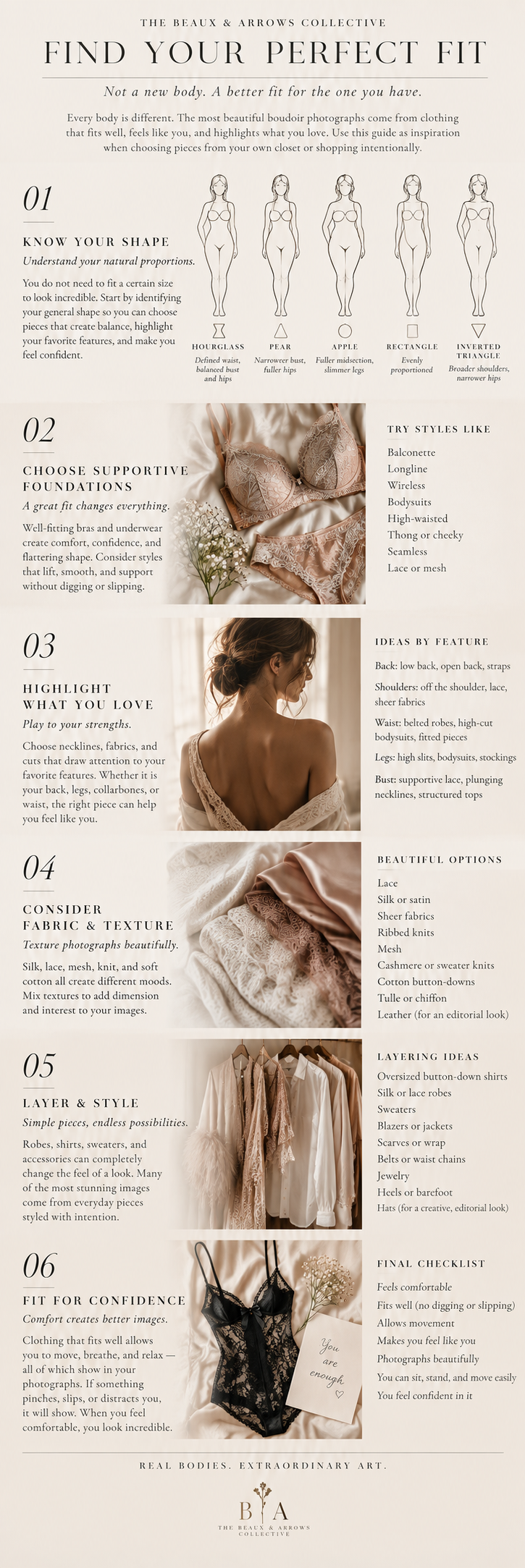
Ignore the number on the tag and pay attention to what happens when you move.
A garment that looks wonderful while you stand perfectly still in front of a dressing room mirror may behave completely differently when you sit, kneel, recline, twist, raise an arm, arch, cross your legs, or shift your weight.
Before your session, try every serious wardrobe contender through what I would call the movement test.
Put it on and spend several minutes actually moving in it.
Sit on the floor.
Sit on the edge of the bed.
Raise both arms.
Turn sideways.
Look at the back.
Walk. Bend. Stretch. Lie down.
Notice whether straps remain where they belong, whether cups gap, whether underwire digs, whether the garment rolls, whether a bodysuit becomes painfully short through the torso, whether stockings stay up, whether a waistband repeatedly needs adjusting, and whether you instinctively begin covering yourself.
The most useful question is not, “Does this make me look thin?”
It is:
“Can I forget that I am wearing this?”
When you can stop managing the garment, you have considerably more emotional space to be photographed.
Think in silhouettes rather than five versions of the same lingerie set
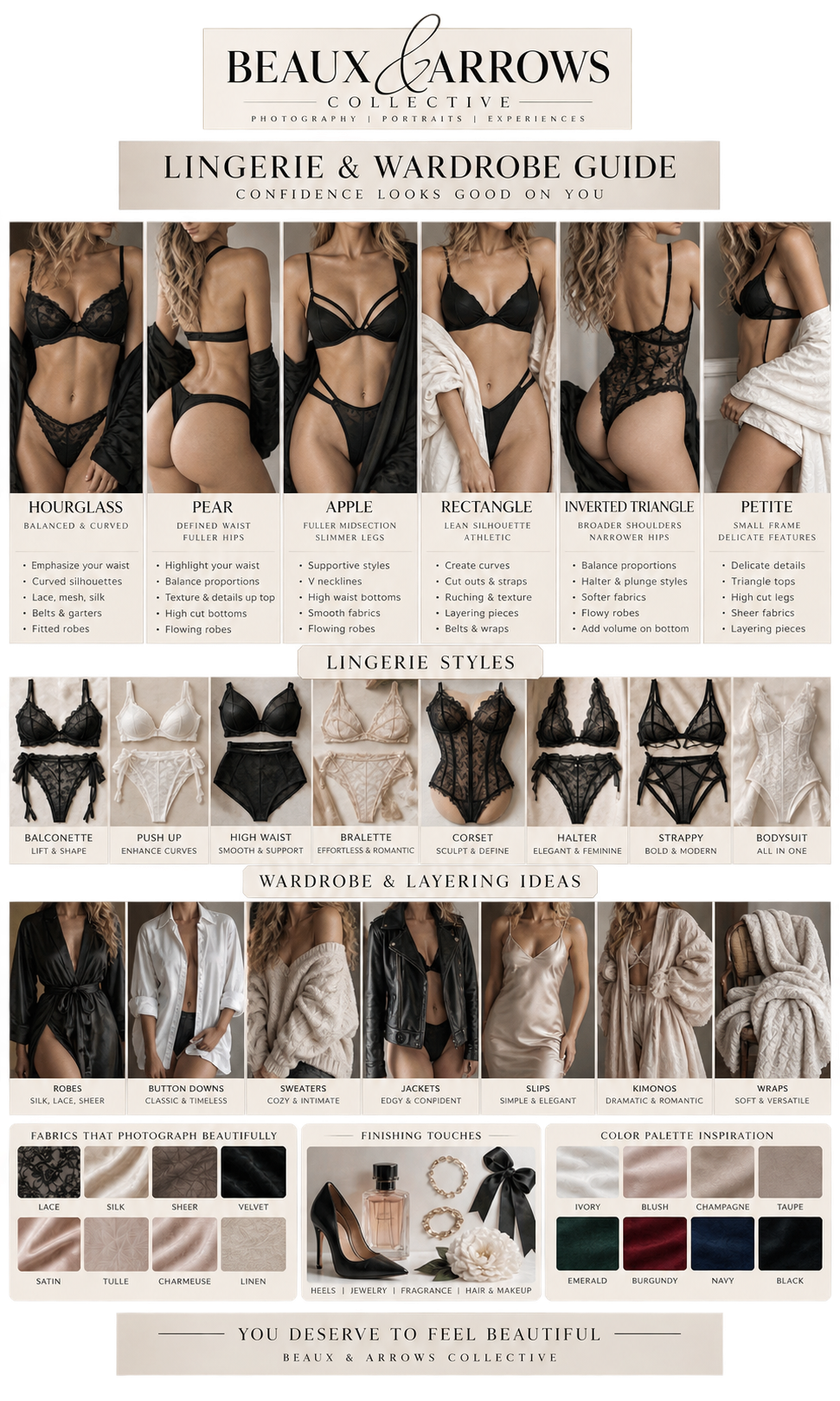
A stronger boudoir wardrobe usually comes from visual contrast.
Instead of bringing five lace bra and panty sets that create essentially the same silhouette, consider giving us several different shapes and levels of coverage.
For example, your possibilities might include a structured bra and panty set, a bodysuit, something soft and oversized, something with long sleeves, and something highly personal or unexpected.
One look may expose more skin while another creates intrigue through coverage; and one may be black and architectural while another is ivory and delicate.
One may feel polished and intentional while another looks as though you simply woke up beautiful in an oversized shirt.
One might be unmistakably bridal.
Variety comes from changing the visual language, not merely changing underwear.
What colors should you choose?
Choose colors in relationship to yourself rather than to a generic boudoir rulebook.
Black is timeless because it creates strong shape and contrast, but it is not automatically the most flattering or most interesting option for every person.
Ivory, cream, champagne, blush, warm nude, chocolate, wine, burgundy, plum, navy, forest, deep red, soft blue, muted florals, and beautifully restrained prints can all work depending upon your coloring, the environment, and the photographs we are creating.
Texture can be just as important as color.
Lace catches light differently from silk.
Velvet absorbs it.
Sheer fabrics create layers.
Knits create softness.
Crisp cotton can feel wonderfully clean and editorial.
Leather creates an entirely different visual vocabulary.
The question is not simply what color makes you look best.
It is what material, shape, color, and movement help tell the story you actually want told.
Three to four weeks before: make beauty appointments only if they belong to your life
A beautiful boudoir session does not require changing your body, but it absolutely benefits from thoughtful preparation. There is an important difference between believing that you need to become thinner, younger, smoother, or otherwise physically different before you deserve to be photographed and simply taking excellent care of the body, hair, skin, hands, feet, and details that are going to appear in extraordinarily high resolution photographs.

This is the point in your boudoir preparation timeline when I recommend looking at your usual beauty and grooming routine and deciding what needs to be scheduled in advance. Hair appointments, manicures and pedicures, brow shaping, waxing or sugaring, teeth whitening, facials, dermaplaning, professional tanning, and other treatments should not become a frantic collection of experiments during the final few days before your session. If you regularly have these services performed and know how your skin, hair, and body respond to them, plan them thoughtfully enough that you can arrive looking beautifully maintained rather than freshly treated.
I want you polished, not transformed into someone else.
Pay particular attention to the details that are easy to overlook in everyday life but become surprisingly visible in photographs. Nails should be clean and intentional, whether that means a beautiful manicure or simply neatly shaped natural nails. Toenails matter if we are photographing bare feet or heels. Brows should look the way you prefer them to look. If your hair is colored, consider whether you want your color refreshed and your roots addressed. If teeth whitening is part of your normal beauty routine, this is the time to think about it rather than attempting something aggressive immediately before your session.
Body grooming deserves the same consideration. If you normally shave, wax, sugar, trim, or otherwise remove body hair, please plan to arrive groomed in the areas that will be visible in your photographs, including your legs, underarms, and bikini area according to the lingerie and level of coverage we are planning. With very minimal lingerie, bodysuits, implied nude photographs, close details, bare legs, raised arms, and movement, considerably more of the body can enter the frame than you might initially expect. I photograph and finish your photographs beautifully, but routine grooming is part of session preparation rather than something I recreate afterward in retouching.
The same principle applies to skin. Healthy looking, comfortably moisturized skin photographs beautifully, while an aggressive last minute facial, unfamiliar peel, new self tanner, freshly irritated wax, or enthusiastic attempt to “fix” something immediately before your session can create redness, dryness, inflammation, uneven color, or sensitivity that you did not have in the first place. Your boudoir session is not the ideal occasion to discover how your skin responds to a brand new treatment. Familiar, predictable and beautifully maintained will almost always serve you better than dramatic experimentation.
If professional beauty rituals make you feel particularly cared for, this is also permission to enjoy them; book the manicure, refresh your hair, have your brows done, schedule the pedicure, and whiten your teeth. Have your usual wax or sugaring appointment. Take care of your skin. Moisturize your body. Indulge in all of those small finishing details that make you look in the mirror afterward and think: there I am.
Preparation is about polish, not correction. Most importantly, please do not rely on retouching as a substitute for preparation. Temporary blemishes and the occasional distraction are one thing; rebuilding routine grooming, replacing neglected nail polish, correcting an uneven self tan, removing extensive body hair, changing hair color, or digitally performing beauty treatments after the fact is something entirely different.
You do not need a different body for beautiful boudoir photographs.
You do, however, deserve to bring the one you have beautifully cared for.
A beauty appointment calendar that leaves room for your skin to behave like skin
Rather than stacking everything into the final forty eight hours, give your body time to respond.
Approximately three to four weeks before
This can be an appropriate window for routine hair color, a familiar haircut, dental cleaning, or other established maintenance that you prefer not to schedule immediately before being photographed.
If you are contemplating a dramatic hair transformation, I would personally prefer significantly more time so you have an opportunity to live with it, style it yourself, and determine whether it actually feels like you.

Approximately one to two weeks before
Routine brow work, gentle familiar skincare, and other low irritation maintenance can happen here according to how your individual skin responds.
If you have never received a particular treatment before, your boudoir appointment is not an especially good deadline for discovering whether your skin likes it.

Approximately three to five days before
If waxing or sugaring is already part of your routine, several days of buffer allows temporary redness or irritation time to settle. Multiple boudoir preparation guides recommend leaving a gap after waxing rather than doing it immediately before photography.

Approximately two to three days before
If you regularly receive a professional spray tan and know exactly how your skin responds, this is a commonly recommended window because it allows guide color to be rinsed away and the tan to settle. A tanning professional writing specifically about boudoir preparation recommends roughly two to three days rather than the day before, partly to reduce transfer onto light fabrics and allow the developed color to stabilize.
If tanning is not already part of your routine, however, I would rather photograph your natural skin than make your boudoir session the test run.
DERMA-PLANING FOR BRIGHT, SMOOTH SKIN
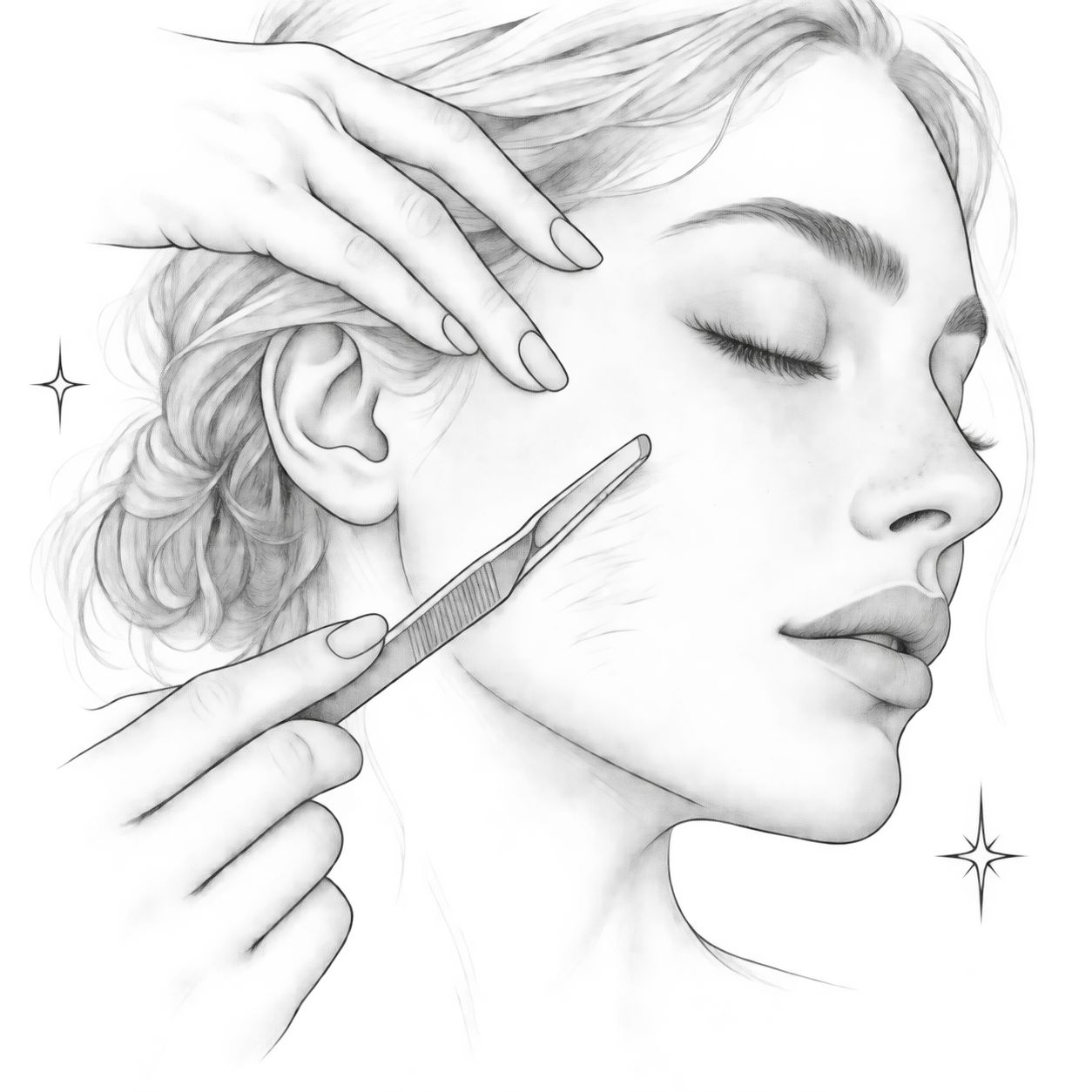
If dermaplaning is something your skin already tolerates beautifully, schedule it according to the advice of the professional who knows your skin rather than assuming it needs to happen the night before.
I would not recommend turning session eve into an aggressive exfoliation event.
Removing facial hair or surface skin immediately before makeup can sound appealing, but irritated skin is considerably less useful to us than skin with a little natural texture.
A Beautiful, Bright, and Healthy Smile
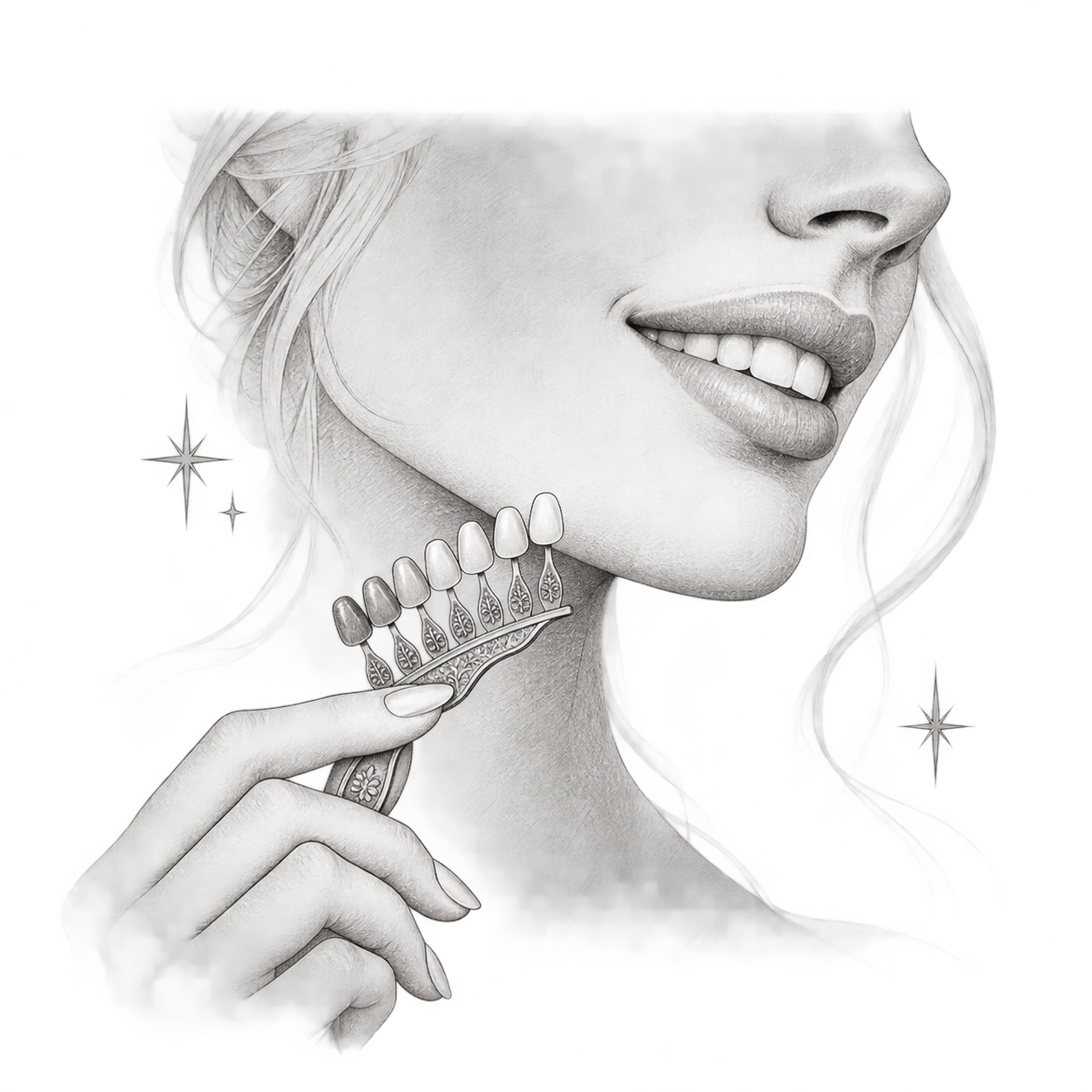
A beautifully cared for smile can subtly brighten the entire face, particularly in close portraits, laughing photographs, softer beauty images, and photographs where the attention naturally falls on your eyes and expression.
I would approach whitening exactly as I approach the rest of your beauty preparation: intentionally, conservatively, and early enough that you are not dealing with the consequences of it on the morning we photograph you.
Whitening can cause temporary tooth or gum sensitivity for some people, which is a fairly miserable thing to discover immediately before spending several hours smiling, talking, changing expressions, drinking something cold, and otherwise trying to enjoy yourself. Rather than aggressively whitening the night before your session, I would much rather have you work with your dentist or an experienced whitening professional to choose an appropriate method and schedule for your own teeth.
There is also no reason to chase an artificial paper white shade. Natural teeth have dimension, translucency, warmth, and individual variation, and that is beautiful. The goal, if you choose to whiten, is simply to arrive with a smile that feels clean, bright and beautifully maintained to you, rather than trying to create something unnaturally white.
If you are due for your normal dental cleaning anyway, scheduling it comfortably ahead of your session can also be an excellent place to begin. Existing dental work can respond differently from natural enamel, and not every type of discoloration responds to whitening in the same way, which is another reason professional guidance can be worthwhile when you want a significant change rather than a subtle at home refresh.
Nails deserve more thought than “always choose nude”
Hands appear everywhere in boudoir.
They frame the face, move through hair, touch shoulders, hold fabric, trace collarbones, rest on thighs, interact with clothing, and become surprisingly prominent compositional elements.
That makes nail care useful, but it does not mean every woman needs the same pale pink manicure.
A beautifully executed French manicure can be timeless as can natural nails… Deep red can be exquisite; black can look exceptionally editorial; and a muted nude can highlight beautifully into the composition.
The important thing is that your hands feel like your hands at their most intentional, because if you never wear long acrylic nails in your ordinary life, your boudoir session may not be the moment to transform your hands into someone else's.
Check toes too, because bare feet appear far more often in boudoir photographs than most clients anticipate.
One to two weeks before: conduct the full wardrobe rehearsal

Do not wait until session morning to discover that the garter clips are broken, the stockings are the wrong color, the bodysuit is transparent under direct light, or the beautiful bra you bought online has one cup doing something entirely different from the other.
Strings, straps, and bows can all be assisted, however tars or damages cannot always.
Put on the shoes — Add jewelry — Look at the outfit from the front, side, and back, and pack it in a suitcase, neatly and abundantly.
The overlooked boudoir packing list
Most guides tell you to bring lingerie and heels, but the little things can make a significant difference.

Wardrobe
□ Three to five strong clothing or lingerie possibilities
□ Black slim panties
□ Nude slim panties
□ Strapless or convertible bra if one of your wardrobe pieces requires it
□ Bodysuits, slips, robes, corsetry, stockings, garters, or other pieces you genuinely enjoy
□ One non lingerie option
□ One piece that feels unmistakably personal
Accessories
□ Earrings
□ Rings
□ Bracelets or bangles
□ Necklaces if they complement rather than overwhelm your neckline
□ Heirloom jewelry
□ Wedding jewelry if appropriate
□ Veil or bridal accessories
□ Hair accessories
□ Heels, boots, or other shoes
Useful little things people forget
□ Hairbrush or comb
□ Lip product for touchups
□ Clear deodorant if that is your preference
□ Contact lens supplies if needed
□ Glasses if you wear them and want photographs in them
□ Any required medications you normally carry
□ Water
□ A snack
□ A robe or comfortable coverup
□ A separate bag for worn lingerie
□ Fashion tape or garment solutions you already know how to use
□ Spare hosiery if hosiery is important to a look
□ Your inspiration notes
□ Anything sentimental we have discussed beforehand
And perhaps most importantly: Packing something does not obligate you to photograph it.
What should stay home?
Anything that requires you to become somebody you do not recognize.
Also leave behind lingerie that does not fit, shoes that are actively painful, jewelry you are terrified of losing, beauty products your skin has never encountered, and an enormous pile of props that will make every photograph about the prop instead of about you.
I would also leave behind the idea that because you purchased something for the session, we are required to use it. We are not.
If we look at it together and decide another option is stronger, the money you spent does not get to dictate the art.
The week before: stop introducing variables
The final week is not the time for experimentation.
Do not suddenly decide that because your session is approaching you should use a much stronger retinoid, perform an aggressive chemical peel, try an unfamiliar body scrub, book your first wax, experiment with a new self tanner, completely change your eyebrow shape, or use a hair product you have never tested.
Boudoir preparation guidance consistently recommends avoiding unfamiliar skincare and dramatic beauty experiments close to the session because redness, irritation, breakouts, and patchiness are considerably harder to predict than your normal skin.
Your ordinary skin is photographable.
Irritated skin is still photographable too, but there was no reason to make yourself uncomfortable.
Moisturize because comfortable skin matters, not because dry skin is unacceptable
Regular body moisturizer in the days before your session can help skin feel comfortable and can reduce visibly flaky areas, particularly around elbows, knees, hands, legs, and feet.
Use something your skin already tolerates.
If you are prone to reactions, this is not the time to buy a heavily fragranced luxury body cream simply because the packaging looked appropriate for boudoir.
The same principle applies to your face.
Maintain the routine that keeps your skin calm.
Do not attack it into submission.
Hydration matters, but you do not need to become a human aquarium
Drink water consistently because hydration supports how you feel, particularly when you will be spending a physically active session posing, changing, talking, and concentrating.
You do not need to force enormous quantities of water immediately before your photographs in the hope that forty eight hours of heroic hydration will fundamentally alter your appearance.
The purpose is comfort, energy, and ordinary wellbeing.
Preparation should make your body feel supported rather than micromanaged.
Protect yourself from accidental marks during the final days
If you know you bruise easily and temporary marks bother you, this is probably not the week to reorganize the attic in shorts.
Likewise, think about sun exposure.
A sudden sunburn immediately before boudoir can be physically uncomfortable as well as visually distracting, so protecting your skin from burning is considerably more useful than trying to acquire a last minute tan.
If you have pets who enthusiastically climb you, garden in thorny plants, perform physically demanding work, or participate in activities likely to leave temporary scratches or bruises, you can simply be a little more mindful during the final days if those temporary marks would bother you.
If they would not, carry on.
Forty eight hours before: simplify everything
By two days before your session, nearly every important decision should already be made.
Your wardrobe does not need further analysis.
Your body does not need further improvement.
Your Pinterest board does not need another eighty photographs.
Your job now is to make session morning easy.
Steam garments if necessary.
Remove tags.
Check shoe soles for stickers.
Untangle jewelry.
Make sure stockings are intact.
Confirm travel logistics.
Place everything together.
Charge your phone.
Know what time you need to leave.
Then go live your life.
The day before: your preparation should feel almost boring
This is a good thing.
Take your normal shower.
Complete your normal grooming.
Moisturize.
Pack your bag.
Eat normally.
Drink water.
Do whatever hair preparation has been recommended for your particular styling plan.
If professional hair services are included, follow the instructions you were given regarding whether your hair should arrive freshly washed, washed the previous evening, completely dry, or otherwise prepared, because hair type and intended styling can change the best approach.
Do not stay awake until midnight trying on lingerie.
Do not begin restricting food because you are afraid breakfast will make your stomach visible.
Do not inspect yourself beneath harsh lighting.
Do not perform an emergency facial.
Do not drink an excessive amount because you are nervous.
Do not scroll through photographs of strangers and evaluate whether you deserve to do this.
Pack.
Prepare.
Sleep.
The morning of your boudoir session: slow is luxurious
If you can control your schedule, do not create a morning in which you wake late, answer seventeen emails, argue with traffic, skip breakfast, spill coffee on yourself, and arrive apologizing.
Give yourself margin.
Wake up.
Drink some water before your second coffee if that helps you feel good.
Stretch gently if movement feels good in your body.
Journal if writing settles your mind.
Take a quiet shower.
Play music.
Eat.
Give yourself enough time that preparation feels ceremonial rather than frantic.
Luxury is not only champagne and expensive lingerie.
Sometimes luxury is simply not rushing.
The everything shower, if you enjoy one
If a long, deliberate shower makes you feel wonderful, session morning can be a lovely time for it, provided you are not using unfamiliar products or aggressively exfoliating freshly sensitive skin.
You might wash and condition your hair according to your styling instructions, shave whatever you normally shave, gently cleanse your skin, moisturize afterward, and take enough time that you feel cared for.
If your hair responds beautifully to air drying, wrapping, diffusing, blowing out, or another routine, follow the method you already understand.
Your body knows its routine.
Trust that knowledge.
Please eat breakfast
This deserves considerably more emphasis than it usually receives.
Boudoir posing is physical.
You may be arching, pointing toes, extending legs, kneeling, sitting, standing, holding muscles, rotating shoulders, moving through your hands, getting on and off furniture, changing clothes repeatedly, and maintaining positions that feel completely different from how they look through the camera.
Multiple boudoir studios explicitly advise clients to eat before the session because posing requires energy.
Please do not arrive hungry because you believe an empty stomach will photograph better.
Eat a breakfast that your body already knows and likes, ideally something satisfying enough to give you stable energy without making you physically uncomfortable.
The photographer can direct your stomach.
The photographer cannot photograph you out of feeling faint.
What should you wear while traveling to the studio?
Wear something loose enough that you are not creating temporary compression marks everywhere we intend to photograph.
Tight bras can leave lines across shoulders and backs.
Tight socks can leave rings around ankles.
Leggings can create waist and seam impressions.
Tight underwear can leave lines through hips.
Many boudoir preparation resources recommend loose clothing before the session for precisely this reason.
This does not mean you need to drive across Maine wrapped in a bedsheet.
Simply choose soft, comfortable clothing without aggressive elastic wherever practical.
A loose dress, relaxed pants, oversized shirt, soft layers, slides, or similar clothing works beautifully.
If professional hair and makeup are happening first, a button front or otherwise easily removable top can also prevent you from dragging clothing over freshly styled hair.
Hair should look like your hair on an exceptional day
I am not interested in giving every woman the same enormous curling iron waves simply because she booked boudoir.
If you have beautiful natural curls, I want to consider your natural curls.
If your hair is straight and sleek, that may be exactly what belongs in the photographs.
If you wear a short architectural cut, we should not try to make you look like somebody with waist length extensions.
If you love volume, let us use volume.
If you love softness, let us create softness.
If you almost always wear your hair up and feel strangely exposed with it down, perhaps an elegant up style or a partially undone version of your usual hair will feel more authentic.
Hair should participate in your identity.
Professional styling should elevate that identity, not replace it.
Makeup should make sense when you look back at these photographs ten years from now
Boudoir does not automatically require extraordinarily heavy makeup, enormous false lashes, aggressive contouring, or a face that looks unfamiliar from six feet away.
Photography benefits from definition, and professional makeup can be extraordinary because the artist understands how complexion, eyes, brows, lips, texture, and dimension translate through light and camera.
But the objective should still be intentional.
Some clients want soft, luminous skin and understated eyes.
Some want a strong lip.
Some want dramatic liner.
Some want almost no visible makeup.
Some want full glamour because that transformation is part of the pleasure.
Preference matters.
If professional makeup is included, communicate rather than simply surrendering your face. Bring references if necessary. Explain what you never wear. Explain what makes you feel beautiful. Tell the artist if you hate heavy foundation or love a particular feature.
You are allowed to have an opinion about your own face.
What if you wake up with a pimple, bruise, shaving nick, scratch, or mystery mark?
Come anyway.
Temporary things are temporary.
Appropriate portrait finishing exists precisely because human bodies occasionally develop blemishes, bruises, mosquito bites, razor irritation, scratches, and inexplicable marks overnight.
I am much more interested in distinguishing those temporary distractions from permanent characteristics.
A pimple that appeared yesterday is not part of your identity.
A scar you have carried for fifteen years may be.
A bruise may disappear next week.
Your freckles are your freckles.
A shaving nick is incidental.
A birthmark may have been part of your body since infancy.
I do not believe those things should automatically receive identical treatment.
Retouching should involve judgment, restraint, and your preferences rather than the assumption that anything distinguishing your skin from polished plastic is a flaw.
Scars, stretch marks, cellulite, texture, loose skin, birthmarks, surgical changes, and the history written on a body
Tell me what matters to you.
That does not mean handing me a list of everything you dislike.
It means allowing us to have an intelligent conversation about how you want to be represented.
You may have a scar you never want removed because surviving the event that created it changed your life.
You may have another you simply do not want emphasized.
You may love your stretch marks.
You may not.
You may be learning to accept changes after pregnancy, weight change, surgery, illness, aging, or simply time.
You may not be interested in turning your boudoir session into a self acceptance seminar at all.
That is also completely acceptable.
You do not owe me a profound emotional relationship with every inch of your body.
You are allowed to say, “I would prefer not to emphasize this.”
That is useful information.
Your mobility matters more than the pose
One thing I would add to almost every traditional boudoir prep guide is a conversation about physical comfort.
Boudoir posing can involve back extension, pointed feet, kneeling, twisting, reaching, lying on the stomach, getting down onto the floor, or placing weight through wrists, knees, hips, shoulders, and other joints.
Not every body should do every pose.
If you have old injuries, hypermobility, arthritis, joint pain, limited range of motion, dizziness, pelvic discomfort, recent surgery, pregnancy related changes, balance concerns, chronic pain, or anything else affecting movement, tell your photographer.
You do not need to disclose a diagnosis you would prefer to keep private.
You can simply say:
“My left knee does not tolerate kneeling.”
“I cannot comfortably arch deeply.”
“Getting onto the floor is fine, but getting back up is difficult.”
“Please avoid putting my weight through this wrist.”
That is enough.
A skilled photographer should adapt the photograph to your body rather than asking your body to suffer for the photograph.
You do not need to know how to pose
This is one of the most common anxieties I hear, and it is also one of the least useful things to worry about.
You are not expected to arrive knowing what to do with your hands.
You are not expected to understand how shifting a hip changes a line, how shoulder position affects the neck, how camera height changes proportion, how light interacts with a turned torso, or how a small adjustment to your chin changes the photograph.
That is photography.
That is my responsibility.
I will direct you.
Sometimes the position that photographs beautifully will feel slightly unusual because your body experiences a pose from the inside while the camera sees only a two dimensional projection from one carefully selected angle.
That is why I do not expect you to judge the photograph solely by how the pose feels.
I want you to see what I am seeing.
I will show you the camera because you deserve to know what we are creating
This is one of the most important parts of how I approach boudoir.
I do not want you spending the entire session wondering whether you look beautiful and being expected to accept my reassurance on faith.
I show clients what I am photographing.
I may place the camera directly into your hands so you can look through the images while we are creating them.
We can discuss what you love.
We can notice what surprised you.
We can identify a particular angle you adore and create more from it.
We can talk about something that does not feel like you.
We can delete something you do not want.
We can change direction.
That feedback makes the session better because I am not photographing an abstract idea of a beautiful woman.
I am photographing you, and your perception of yourself belongs in the process.
Consent is allowed to change while we are photographing
Agreeing to boudoir does not mean agreeing to every possible boudoir photograph.
Agreeing to wear lingerie does not mean agreeing to implied nude photographs.
Agreeing to one revealing image does not mean you have established a permanent level of exposure for the remainder of the session.
Agreeing to an idea during planning does not prevent you from changing your mind when the moment arrives.
You can ask for more coverage.
You can ask for less.
You can decline a pose.
You can change wardrobe.
You can take a break.
You can ask to see the camera.
You can tell me something does not feel right without providing a justification.
Comfort and consent are not administrative obstacles that need to be handled before creativity begins.
They are part of creating good work.
Should you bring a friend?
A support person can be wonderful when that person's presence genuinely makes you more relaxed.
Choose carefully.
The right person will tell you that you look incredible without trying to control the session.
They will respect your privacy.
They will not laugh at vulnerable moments.
They will not pressure you into revealing more.
They will not stand behind me shouting posing instructions.
They will not make comments about your body that remain in your head for the rest of the afternoon.
Some clients become more comfortable with a trusted friend nearby.
Others discover that they are dramatically freer without anyone they know watching.
Neither choice is more confident.
Choose the environment in which you can stop performing.
Bring music if music changes you
This is a tiny detail that can dramatically affect movement and expression.
If there is music that makes you feel powerful, feminine, relaxed, nostalgic, playful, romantic, or completely yourself, tell me.
A playlist can change the pace of a session.
It can help someone stop thinking about where her hands are.
It can turn a static pose into movement.
It can give us laughter.
It can help someone inhabit the room rather than simply stand inside it.
Your session should not sound like an elevator unless you particularly enjoy elevators.
Bring scent carefully, or not at all
Perfume can be part of someone's identity, but fragrance can also become overwhelming in an enclosed studio, particularly for people with sensitivities.
If wearing your signature fragrance makes you feel unmistakably yourself, a light application may be lovely.
If you are sensitive, skip it.
This is another example of something that should be based on identity and comfort rather than a prescribed boudoir ritual.
Consider your menstrual cycle only insofar as it matters to you
There is no universal reason you cannot have boudoir photographs while menstruating.
Some people feel completely normal.
Others experience significant bloating, cramping, breast tenderness, skin changes, fatigue, migraines, or simply do not feel comfortable wearing certain lingerie during that part of their cycle.
If your cycle reliably changes how you physically feel and you have scheduling flexibility, you may prefer to consider it when choosing a date.
If your period arrives unexpectedly, however, that does not automatically mean the session is ruined.
Bring whatever menstrual products make you comfortable, tell me privately if there is anything we should adjust, and we can adapt.
Your body does not need to apologize for having a body.
Think about glasses, contacts, hearing devices, medical devices, and the things that are actually part of you
Do not automatically remove something because you assume portraits require it.
If you wear glasses every day and feel unlike yourself without them, bring them.
We can manage reflections intentionally.
If you use a hearing device, mobility aid, medical device, prosthesis, ostomy appliance, scar support, or another item connected to your body, the question is not automatically, “How do we hide this?”
The question is:
“How do you want to be photographed?”
Some people want something visible because it is part of their body and life.
Others prefer discretion.
Both deserve respect.
Privacy should be discussed before you undress, not after the gallery exists
Boudoir photography involves images that may be extraordinarily private, which means every client should understand how photographs are stored, delivered, displayed, published, shared, and retained before the session occurs.
Ask questions.
Is your gallery private?
Who can access it?
Does your photography agreement automatically authorize portfolio use?
Can you approve individual photographs for sharing while keeping others private?
Can you decline publication completely?
Are intimate images shown on social media?
How are albums packaged and delivered?
Who handles printing?
How long is your gallery available?
Privacy is not an awkward subject.
It is part of professional boudoir photography.
Think about where the photographs will ultimately live
One of the most overlooked preparation decisions happens after the camera is put away.
Do you want these photographs to remain digital files on a phone?
Do you want a private album?
A beautiful folio collection?
A framed portrait intended only for a bedroom or dressing room?
A gift?
A collection that belongs entirely to you?
Thinking about this beforehand can change how we photograph.
An album benefits from visual storytelling, transitions, details, wider environmental photographs, close portraits, and enough variation to create rhythm from page to page.
A framed piece may call for a composition designed around the physical dimensions and location where it will ultimately hang.
A gift may benefit from different choices than something created solely for yourself.
The product should not dictate the entire session, but knowing the destination gives the photographs somewhere to go.
Your final 72 hour checklist
This is the point at which I want preparation becoming smaller rather than larger.
Seventy two hours before
□ Complete routine waxing or sugaring if desired and if your skin already tolerates it.
□ Complete your manicure and pedicure within whatever window reliably keeps them looking fresh.
□ Confirm your final wardrobe possibilities.
□ Check every garment for tags, damage, missing closures, loose threads, and fit.
□ Confirm jewelry and accessories.
□ Avoid new skincare products.
□ Avoid dramatic beauty experiments.
□ Protect yourself from sunburn.
□ Moisturize according to your normal routine.
□ Eat normally.
□ Sleep normally.
Forty eight hours before
□ Steam or press clothing where appropriate.
□ Organize jewelry.
□ Check stockings and hosiery.
□ Remove stickers from shoe soles.
□ Prepare black and nude underwear.
□ Confirm directions and timing.
□ Decide what you are wearing to the studio.
□ Begin packing rather than leaving everything until the morning.
Twenty four hours before
□ Finish packing.
□ Follow your established hair washing schedule.
□ Complete familiar shaving or grooming if desired.
□ Moisturize.
□ Eat dinner.
□ Drink water normally.
□ Avoid excessive alcohol if it affects your sleep or how you feel the following morning.
□ Set your alarm with generous time.
□ Stop looking for things to fix.
Your session morning checklist
□ Wake up with enough time that you do not need to rush.
□ Drink water.
□ Eat a real breakfast.
□ Stretch gently if your body enjoys it.
□ Shower according to your normal routine.
□ Complete grooming according to your personal preference.
□ Moisturize and allow products to absorb.
□ Prepare your face according to your hair and makeup instructions.
□ Brush and floss your teeth.
□ Remove hair ties from wrists before they leave temporary impressions.
□ Remove tight socks, bras, or restrictive clothing early enough to allow marks to fade if that matters to you.
□ Wear loose, comfortable clothing.
□ Pack water and a snack.
□ Bring your wardrobe bag.
□ Bring your jewelry.
□ Bring your shoes.
□ Bring your glasses or contact supplies if relevant.
□ Bring necessary personal or medical items.
□ Bring your playlist if you have one.
□ Bring the things that make the photographs personal.
□ Leave the expectation of perfection at home.
And one final checklist that matters more than all the others
Before you walk through the door, I would rather you be able to check these boxes than any beauty appointment on this page:
□ I understand that I do not need to know how to pose.
□ I understand that I can change my mind.
□ I understand that I can ask to see the photographs.
□ I understand that I can tell Rebecca what I love.
□ I understand that I can tell Rebecca what I do not love.
□ I understand that wearing something does not obligate me to photograph it.
□ I understand that bringing something does not obligate me to use it.
□ I understand that more skin does not automatically create a better photograph.
□ I understand that less skin does not make my session less legitimate.
□ I understand that my scars, stretch marks, freckles, body hair, age, shape, skin texture, and other permanent characteristics are not automatically defects requiring correction.
□ I understand that temporary blemishes do not determine whether I am ready to be photographed.
□ I understand that I do not need to arrive confident.
□ I understand that I am allowed to be nervous.
□ I understand that this experience does not belong to the person receiving the album, even if the album is a gift.
□ I understand that I am the person being photographed, and my comfort matters throughout the entire process.
That is boudoir preparation.
Everything else is logistics.
Beaux & Arrows
Maine Boudoir Photography by Rebecca Pinkham Stevenson
Private Boudoir Portraiture • Bridal Boudoir • Intimate Portraits • Professional Hair + Makeup • Wardrobe Guidance • Private Galleries • Albums • Fine Art Prints • Thoughtful Retouching • Client Directed Privacy